
 NEML2
NEML2
Calibrating a crystal-plasticity model with pyzag#
The pyzag tutorial and the deterministic / statistical notebooks calibrate a scalar viscoplastic model. Here we take the same chunked-adjoint machinery to a much stiffer problem: a Taylor polycrystal, where every grain integrates its own elastic strain, orientation, and slip hardening, and all grains share one global deformation-rate / stress state.
That per-grain-plus-global structure is a BLOCK + DENSE system: the pyzag backend keeps each grain’s state in a per-site (BLOCK) group and the global mixed-control unknowns in a DENSE group, solving the coupled step with a Schur complement. We calibrate two slip/Voce hardening parameters from a synthetic macroscopic stress–strain curve.
The roadmap:
Write the mixed-control crystal-plasticity model and wrap it for pyzag.
Build a synthetic experiment (random grain orientations + a strain ramp).
Generate a ground-truth curve, then perturb the hardening parameters.
Recover them with LBFGS through the chunked adjoint.
The material model#
We write the model to an input file. It is a mixed-control Taylor crystal
plasticity model (FCC, {111}<110> slip): elasticity from named cubic constants,
a power-law slip rule with Voce single-slip hardening, and backward-Euler
integration of each grain’s elastic strain, orientation, and slip hardening. The
[EquationSystems] block declares the two-group structure = 'block dense' split
(per-grain unknowns; global mixed-control unknowns) solved by a SchurComplement.
%%writefile model.i
# Mixed-control Taylor crystal-plasticity model. The elastic stiffness is built
# from named (E, nu, G) coefficients via CubicElasticityTensor so each is a
# tunable NEML2 parameter mirrored as a torch.nn.Parameter by NEML2PyzagModel.
# Two Voce/slip hardening parameters are calibrated in this tutorial:
#   slip_strength_constant_strength      (initial slip resistance, MPa)
#   voce_hardening_initial_slope         (initial hardening slope, MPa)

[Tensors]
  [sdirs]
    type = Python
    expr = 'MillerIndex(torch.tensor([1, 1, 0], dtype=torch.int64))'
  []
  [splanes]
    type = Python
    expr = 'MillerIndex(torch.tensor([1, 1, 1], dtype=torch.int64))'
  []
[]

[Data]
  [crystal_geometry]
    type = CubicCrystal
    lattice_parameter = 1
    slip_directions = 'sdirs'
    slip_planes = 'splanes'
  []
[]

[Models]
  # Mixed control (global)
  [mixed_control]
    type = MixedControlSetup
    x_above = 'deformation_rate'
    x_below = 'target_cauchy_stress'
    y = 'mixed_state'
  []
  [y_constraint]
    type = SR2LinearCombination
    from = 'mixed_state prescribed'
    to = 'y_residual'
    weights = '1 -1'
  []

  # Per-crystal update
  [euler_rodrigues]
    type = RotationMatrix
    from = 'orientation'
    to = 'orientation_matrix'
  []
  [elastic_tensor]
    type = CubicElasticityTensor
    coefficient_types = 'YOUNGS_MODULUS POISSONS_RATIO SHEAR_MODULUS'
    coefficients = '100000 0.307 11046.58'
  []
  [elasticity]
    type = GeneralElasticity
    elastic_stiffness_tensor = 'elastic_tensor'
    strain = 'elastic_strain'
    stress = 'cauchy_stress'
  []
  [resolved_shear]
    type = ResolvedShear
    stress = 'cauchy_stress'
  []
  [elastic_stretch]
    type = ElasticStrainRate
    deformation_rate = 'deformation_rate'
  []
  [plastic_spin]
    type = PlasticVorticity
  []
  [plastic_deformation_rate]
    type = PlasticDeformationRate
  []
  [orientation_rate]
    type = OrientationRate
  []
  [sum_slip_rates]
    type = SumSlipRates
  []
  [slip_rule]
    type = PowerLawSlipRule
    n = 20
    gamma0 = 0.0001
  []
  [slip_strength]
    type = SingleSlipStrengthMap
    constant_strength = 120.0
  []
  [voce_hardening]
    type = VoceSingleSlipHardeningRule
    initial_slope = 10.0
    saturated_hardening = 155.0
  []
  [integrate_slip_hardening]
    type = ScalarBackwardEulerTimeIntegration
    variable = 'slip_hardening'
  []
  [integrate_elastic_strain]
    type = SR2BackwardEulerTimeIntegration
    variable = 'elastic_strain'
  []
  [integrate_orientation]
    type = WR2ImplicitExponentialTimeIntegration
    variable = 'orientation'
  []
  [per_crystal_update]
    type = ComposedModel
    models = 'elasticity euler_rodrigues
              orientation_rate resolved_shear
              elastic_stretch
              plastic_deformation_rate plastic_spin
              sum_slip_rates slip_rule slip_strength voce_hardening
              integrate_slip_hardening
              integrate_elastic_strain
              integrate_orientation'
    additional_outputs = 'cauchy_stress'
  []

  # Global constraint
  [mean_stress]
    type = SR2IntermediateMean
    from = 'cauchy_stress'
    to = 'mean_cauchy_stress'
    reduces = 'grain'
  []
  [match_mean_cauchy_stress]
    type = SR2LinearCombination
    from = 'target_cauchy_stress mean_cauchy_stress'
    to = 'target_cauchy_stress_residual'
    weights = '1 -1'
  []
  [global_constraint]
    type = ComposedModel
    models = 'mean_stress match_mean_cauchy_stress'
  []

  # Full implicit model
  [implicit_model]
    type = ComposedModel
    models = 'mixed_control y_constraint per_crystal_update global_constraint'
  []
[]

[EquationSystems]
  [eq_sys]
    type = NonlinearSystem
    model = 'implicit_model'
    unknowns = 'elastic_strain orientation slip_hardening; deformation_rate target_cauchy_stress'
    residuals = 'elastic_strain_residual orientation_residual slip_hardening_residual; y_residual target_cauchy_stress_residual'
    structure = 'block dense'
  []
[]

[Solvers]
  [newton]
    type = NewtonWithLineSearch
    max_linesearch_iterations = 5
    linear_solver = 'schur'
  []
  [lu]
    type = DenseLU
  []
  [schur]
    type = SchurComplement
    residual_primary_group = '0'
    unknown_primary_group = '0'
    primary_solver = 'lu'
    schur_solver = 'lu'
  []
[]

[Models]
  [predictor]
    type = ConstantExtrapolationPredictor
    unknowns_SR2 = 'elastic_strain deformation_rate target_cauchy_stress'
    unknowns_MRP = 'orientation'
    unknowns_Scalar = 'slip_hardening'
  []
  [model_bare]
    type = ImplicitUpdate
    equation_system = 'eq_sys'
    solver = 'newton'
    predictor = 'predictor'
  []
  [compute_mixed_state]
    type = MixedControlSetup
    x_above = 'deformation_rate'
    x_below = 'target_cauchy_stress'
    y = 'mixed_state'
  []
  [model]
    type = ComposedModel
    models = 'model_bare compute_mixed_state'
    additional_outputs = 'mixed_state'
  []
[]
Writing model.i
Setup#
Imports, the calibration configuration, and the reproducibility knobs.
import sys

import matplotlib.pyplot as plt
import torch
from pyzag import chunktime, nonlinear, reparametrization

import neml2
import neml2.types
from neml2.pyzag import NEML2PyzagModel

torch.manual_seed(42)
torch.set_default_dtype(torch.float64)
device = torch.device("cuda" if torch.cuda.is_available() else "cpu")
torch.set_default_device(device)

# Kept small so the tutorial runs quickly; scale these up for real work.
NGRAINS = 25
NTIME = 40
NCHUNK = 5
N_ITER = 5
MAX_STRAIN = 0.02
RATE = 1.0e-4
AXIAL = 2  # index of the axial component in the 6-vector Mandel state

# Calibrate the two hardening parameters the 2%-strain curve is sensitive to.
# (Voce saturated hardening only bites near saturation -- slip ~ tau_sat/theta0,
# far beyond this strain -- so it is left fixed rather than fit unidentifiably.)
CALIBRATION_PARAMS = [
    "slip_strength_constant_strength",
    "voce_hardening_initial_slope",
]
# Physically sensible ranges used to rescale the optimizer's search space.
PARAM_RANGES = {
    "slip_strength_constant_strength": (1.0, 2_000.0),
    "voce_hardening_initial_slope": (1e-3, 50_000.0),
}
# Multiplicative offsets applied to the truth to make the (wrong) starting guess.
PERTURB = {
    "slip_strength_constant_strength": 0.75,
    "voce_hardening_initial_slope": 2.0,
}
/home/tranh/miniconda3/envs/neml2_pyzag_ci/lib/python3.12/site-packages/torch/cuda/__init__.py:187: UserWarning: CUDA initialization: The NVIDIA driver on your system is too old (found version 12040). Please update your GPU driver by downloading and installing a new version from the URL: http://www.nvidia.com/Download/index.aspx Alternatively, go to: https://pytorch.org to install a PyTorch version that has been compiled with your version of the CUDA driver. (Triggered internally at /pytorch/c10/cuda/CUDAFunctions.cpp:119.)
  return torch._C._cuda_getDeviceCount() > 0
A synthetic experiment#
No external dataset is needed: we draw random uniform-on-SO(3) grain orientations
(as MRPs, the model’s orientation parametrization) and a constant-rate axial strain
ramp. random_orientations returns a typed neml2.types.MRP that feeds straight
into the state – no raw-tensor unwrapping.
def random_orientations(ngrains):
    g = torch.randn(ngrains, 3, 3)
    q, r = torch.linalg.qr(g)
    q = q * torch.sign(torch.diagonal(r, dim1=-2, dim2=-1)).unsqueeze(-2)
    q[:, :, 0] = q[:, :, 0] * torch.linalg.det(q).unsqueeze(-1)
    return neml2.types.MRP.from_matrix(neml2.types.R2(q, 1))


def strain_time_grid(max_strain, ntime, rate):
    strain = torch.linspace(0.0, max_strain, ntime)
    return strain, strain / rate


orientations = random_orientations(NGRAINS)
strain, times = strain_time_grid(MAX_STRAIN, NTIME, RATE)
Wrap the model for pyzag#
NEML2PyzagModel adapts the NEML2 nonlinear system to pyzag’s
NonlinearFunctionOperatorFactory, mirroring the include_parameters as
torch.nn.Parameters. neml2.compile then JIT-compiles the residual/Jacobian
evaluation in place (a transparent, in-place acceleration; the first call pays a
one-time compile cost), so each Newton and adjoint step runs a fused graph.
nsys = neml2.load_nonlinear_system("model.i", "eq_sys")
model = NEML2PyzagModel(nsys, include_parameters=CALIBRATION_PARAMS)
neml2.compile(model)
NEML2PyzagModel()
The differentiable module#
A thin torch.nn.Module that assembles the initial state and the per-step driving
forces once, then returns the predicted macroscopic axial stress trajectory.
forward differentiates through the chunked solve with nonlinear.solve_adjoint
(the memory-efficient adjoint).
class CrystalCalibration(torch.nn.Module):
    def __init__(self, model, orientations, strain, times, nchunk):
        super().__init__()
        self.model = model
        self.nchunk = nchunk
        self.orientations = orientations  # typed MRP, on-device already
        self.register_buffer("strain", strain)

        ngrains = orientations.shape[0]
        ntime = strain.shape[0]
        dtype = orientations.dtype
        nbatch = 1
        ic = {
            "elastic_strain": torch.zeros(nbatch, ngrains, 6, dtype=dtype),
            "orientation": orientations.dynamic_batch.unsqueeze(0),
            "slip_hardening": torch.zeros(nbatch, ngrains, dtype=dtype),
            "deformation_rate": torch.zeros(nbatch, 6, dtype=dtype),
            "target_cauchy_stress": torch.zeros(nbatch, 6, dtype=dtype),
        }
        self._y0 = model.assemble_state(ic, dynamic_dim=1)

        control = torch.zeros(ntime, nbatch, 6, dtype=dtype)
        control[..., AXIAL] = 1.0  # prescribe the axial deformation rate
        prescribed = torch.zeros(ntime, nbatch, 6, dtype=dtype)
        prescribed[..., AXIAL] = RATE
        forces = {
            "control": control,
            "prescribed": prescribed,
            "t": times.reshape(ntime, 1).expand(ntime, nbatch).contiguous(),
            "vorticity": torch.zeros(ntime, nbatch, 3, dtype=dtype),
        }
        self._forces = model.assemble_forces(forces, dynamic_dim=2)
        self._ntime = ntime

    @property
    def calibration_parameters(self):
        params = getattr(self.model, "parametrizations", None)
        out = []
        for name in CALIBRATION_PARAMS:
            if params is not None and name in params:
                out.append(params[name].original)
            else:
                out.append(getattr(self.model, name))
        return out

    def _solver(self, direct_solve_operator):
        return nonlinear.RecursiveNonlinearEquationSolver(
            self.model,
            step_generator=nonlinear.StepGenerator(self.nchunk),
            predictor=nonlinear.PreviousStepsPredictor(),
            direct_solve_operator=direct_solve_operator,
            nonlinear_solver=chunktime.ChunkNewtonRaphsonLineSearch(
                rtol=1e-6, atol=1e-8, linesearch_iter=5
            ),
        )

    def forward(self, direct_solve_operator=chunktime.BidiagonalThomasFactorization):
        solver = self._solver(direct_solve_operator)
        traj = nonlinear.solve_adjoint(solver, self._y0, self._ntime, self._forces)
        return traj[..., -6 + AXIAL].squeeze(-1)


def rescale_parameters(module):
    """Wrap each calibration parameter in RangeRescale for scaled-space LBFGS."""
    dtype = module.orientations.dtype
    mapping = {
        f"model.{name}": reparametrization.RangeRescale(
            torch.tensor(lo, dtype=dtype), torch.tensor(hi, dtype=dtype), clamp=True
        )
        for name, (lo, hi) in PARAM_RANGES.items()
    }
    reparametrization.Reparameterizer(mapping, error_not_provided=False)(module)


module = CrystalCalibration(model, orientations, strain, times, NCHUNK).to(device)
Ground truth and a perturbed start#
We evaluate the model at its default hardening parameters to make a synthetic
target, then multiply those parameters by PERTURB to get a deliberately-wrong
starting guess.
truth = {n: float(getattr(model, n).detach()) for n in CALIBRATION_PARAMS}
with torch.no_grad():
    target = module()

with torch.no_grad():
    for name, factor in PERTURB.items():
        getattr(model, name).mul_(factor)
    model._update_parameter_values()
    pred_init = module()
started = {n: float(getattr(model, n).detach()) for n in CALIBRATION_PARAMS}
print("truth:  ", {k: round(v, 3) for k, v in truth.items()})
print("started:", {k: round(v, 3) for k, v in started.items()})
/home/tranh/.claude_tmp/ipykernel_2352609/3253022097.py:47: UserWarning: pyzag lowered torch._functorch.config.donated_buffer's default to False process-wide. AOTAutograd 'donated buffers' (torch>=2.12) are incompatible with pyzag's retain_graph=True adjoint over torch.compile'd models, which otherwise raises 'compiled with non-empty donated buffers'. To keep donated buffers enabled, restore torch._functorch.config._config['donated_buffer'].default = True -- compiled models differentiated through the adjoint will then error.
  return nonlinear.RecursiveNonlinearEquationSolver(
W0804 13:03:30.053000 2352609 site-packages/torch/utils/cpp_extension.py:140] [1/0] No CUDA runtime is found, using CUDA_HOME='/usr/local/cuda'
truth:   {'slip_strength_constant_strength': 120.0, 'voce_hardening_initial_slope': 10.0}
started: {'slip_strength_constant_strength': 90.0, 'voce_hardening_initial_slope': 20.0}
Calibrate through the chunked adjoint#
We rescale the parameters into [0, 1] space (LBFGS is sensitive to conditioning),
then run LBFGS with a strong-Wolfe line search. Each closure call runs the full
chunked solve and backpropagates through it via the adjoint – so the peak memory
scales with the chunk size, not the full time history.
rescale_parameters(module)

optimizer = torch.optim.LBFGS(
    module.calibration_parameters, lr=1.0, max_iter=20, line_search_fn="strong_wolfe"
)
history = []


def closure():
    optimizer.zero_grad()
    loss = ((module() - target) ** 2).mean()
    loss.backward()
    return loss


for it in range(N_ITER):
    loss = float(optimizer.step(closure).detach())
    history.append(loss)
    print(f"iter {it + 1:2d}  loss = {loss:.6e}")

with torch.no_grad():
    pred_final = module()
recovered = {n: float(getattr(model, n).detach()) for n in CALIBRATION_PARAMS}
assert history[-1] < history[0]
iter 1 loss = 2.499914e+03
iter 2 loss = 1.781305e-10
iter 3 loss = 1.781305e-10
iter 4 loss = 1.781305e-10
iter 5 loss = 1.781305e-10
Results#
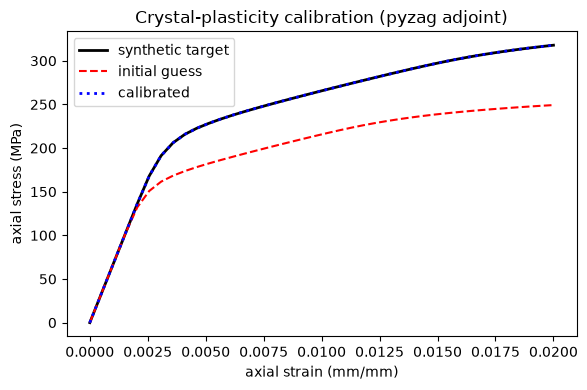
The loss drops by orders of magnitude and the recovered parameters return to the ground truth; the calibrated stress–strain curve lands back on the synthetic target.
print(f"loss {history[0]:.3e} -> {history[-1]:.3e}")
for n in CALIBRATION_PARAMS:
    print(f"{n:38s} truth={truth[n]:10.3f}  recovered={recovered[n]:10.3f}")

s = strain.detach().cpu().numpy()
fig, ax = plt.subplots(figsize=(6, 4))
ax.plot(s, target.detach().cpu().numpy(), "k-", lw=2, label="synthetic target")
ax.plot(s, pred_init.detach().cpu().numpy(), "r--", label="initial guess")
ax.plot(s, pred_final.detach().cpu().numpy(), "b:", lw=2, label="calibrated")
ax.set_xlabel("axial strain (mm/mm)")
ax.set_ylabel("axial stress (MPa)")
ax.set_title("Crystal-plasticity calibration (pyzag adjoint)")
ax.legend()
fig.tight_layout()
loss 2.500e+03 -> 1.781e-10
slip_strength_constant_strength        truth=   120.000  recovered=   120.000
voce_hardening_initial_slope           truth=    10.000  recovered=     9.999
Where to go next#
The scalar-viscoplastic versions of this workflow are the deterministic (point estimate) and statistical (Bayesian / SVI) notebooks.
The pyzag tutorial explains why the chunked adjoint is needed for time-history calibration.
For the underlying algorithms (chunk factorizations, predictors, block-size trade-offs), see the pyzag documentation.