pyzag.nonlinear
Basic functionality for solving recursive nonlinear equations and calculating senstivities using the adjoint method
- class pyzag.nonlinear.ExtrapolatingPredictor
Predict by extrapolating the values from the previous single steps
- predict(results, k, kinc)
Predict the next steps
- Parameters:
results (torch.tensor) – current results tensor, filled up to step k.
k (int) – start of current chunk
kinc (int) – next number of steps to predict
- class pyzag.nonlinear.FullTrajectoryPredictor(history)
Predict steps using a complete user-provided trajectory
This is often used during optimization runs, where the provided trajectory could be the results from the previous step in the optimization routine
- Parameters:
history (torch.tensor) – tensor of shape
 giving a complete previous trajectory
- predict(results, k, kinc)
Predict the next steps
- Parameters:
results (torch.tensor) – current results tensor, filled up to step k.
k (int) – start of current chunk
kinc (int) – next number of steps to predict
- class pyzag.nonlinear.InitialOffsetStepGenerator(*args, initial_steps=None, **kwargs)
Generate chunks of recursive steps to produce at once
The user can provide a list of initial chunks to use, after which the object goes back to chunks of block_size
- Parameters:
block_size (int) – regular chunk size
initial_steps (list of int) – initial steps
- class pyzag.nonlinear.LastStepPredictor
Predict by providing the values from the previous single step
- predict(results, k, kinc)
Predict the next steps
- Parameters:
results (torch.tensor) – current results tensor, filled up to step k.
k (int) – start of current chunk
kinc (int) – next number of steps to predict
- class pyzag.nonlinear.NonlinearRecursiveFunction(*args, **kwargs)
Basic structure of a nonlinear recursive function
This class has two basic responsibilities, to define the residual and Jacobian of the function itself and second to define the lookback.
The function and Jacobian are defined through forward so that this class is callable.
The lookback is defined as a property
The function here defines a series through the recursive relation

We denote the number of past entries in the time series used in defining this residual function as the lookback. A function with a lookback of 1 has the definition

A lookback of 2 is

etc.
For the moment this class only supports functions with a lookback of 1!.
The function also must provide the Jacobian of the residual with respect to each input. So a function with lookback 1 must provide both
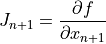
and

The input and output shapes of the function as dictated by the lookback and the desired amount of time-vectorization. Let’s call the number of time steps to be solved for at once
 and the lookback as
 . Let’s say our function has a state size
  .
Our convention is the first dimension of input and output is the batch time axis and the last
dimension is the true state size. The input shape of the state
.
Our convention is the first dimension of input and output is the batch time axis and the last
dimension is the true state size. The input shape of the state  must be
 where
where  indicates some arbitrary
number of batch dimensions. The output shape of the nonlinear residual will be
indicates some arbitrary
number of batch dimensions. The output shape of the nonlinear residual will be
 . The output shape of the Jacobian will be
 .
.Additionally, we allow the function to take some driving forces as input. Mathematically we could envision these as an additional input tensor
 with shape
  and
we expand the residual function definition to be
and
we expand the residual function definition to be
However, for convience we instead take these driving forces as python *args and **kwargs. Each entry in *args and **kwargs must have a shape of
 and we leave it to the user to use each entry as they see fit.
To put it another way, the only hard requirement for driving forces is that the first dimension of the tensor must be slicable in the same way as the state
.
- class pyzag.nonlinear.Predictor
Base class for predictors
- class pyzag.nonlinear.PreviousStepsPredictor
Predict by providing the values from the previous chunk of steps steps
- predict(results, k, kinc)
Predict the next steps
- Parameters:
results (torch.tensor) – current results tensor, filled up to step k.
k (int) – start of current chunk
kinc (int) – next number of steps to predict
- class pyzag.nonlinear.RecursiveNonlinearEquationSolver(func, step_generator: ~pyzag.nonlinear.StepGenerator = <pyzag.nonlinear.StepGenerator object>, predictor: ~pyzag.nonlinear.Predictor = <pyzag.nonlinear.ZeroPredictor object>, direct_solve_operator: type[~pyzag.chunktime.BidiagonalOperator] = <class 'pyzag.chunktime.BidiagonalThomasFactorization'>, nonlinear_solver: ~pyzag.chunktime.NonlinearSolver = <pyzag.chunktime.ChunkNewtonRaphson object>, callbacks=None, convert_nan_gradients=True)
Generates a time series from a recursive nonlinear equation and (optionally) uses the adjoint method to provide derivatives
The series is generated in a batched manner, generating
block_sizesteps at a time.- Parameters:
func (
pyzag.nonlinear.NonlinearRecursiveFunction) – defines the nonlinear system- Keyword Arguments:
step_generator (
pyzag.nonlinear.StepGenerator) – iterator to generate the blocks to integrate at once, default has a block size of 1 and no special fist steppredictor (
pyzag.nonlinear.Predictor) – how to generate guesses for the nonlinear solve. Default uses all zerosdirect_solve_operator (
pyzag.chunktime.LUFactorization) – how to solve the batched, blocked system of equations. Default is to use Thomas’s methodnonlinear_solver (
pyzag.chunktime.ChunkNewtonRaphson) – how to solve the nonlinear system, default is plain Newton-Raphsoncallbacks (None or list of functions) – callback functions to apply after a successful step
convert_nan_gradients (bool) – if True, convert NaN gradients to zero
- accumulate(grad_result, full_adjoint, R, retain=False)
Accumulate the updated gradient values
- Parameters:
grad_result (tuple of tensor) – current gradient results
full_adjoint (torch.tensor) – adjoint values
R (torch.tensor) – function values, for AD
- Keyword Arguments:
retain (bool) – if True, retain the AD graph for a second pass
- block_update(prev_solution, solution, forces)
Actually update the recursive system
- Parameters:
prev_solution (tensor) – previous lookback steps of solution
solution (tensor) – guess at nchunk steps of solution
forces (list of tensors) – driving forces for next chunk plus lookback, to be passed as
*args
- block_update_adjoint(J, grads, a_prev)
Do the blocked adjoint solve
- Parameters:
J (torch.tensor) – block of jacobians
grads (torch.tensor) – block of gradient values
a_prev (torch.tensor) – previous adjoint value
- Returns:
next block of updated adjoint values
- Return type:
adjoint_block (torch.tensor)
- forward(*args, **kwargs)
Alias for solve
- Parameters:
y0 (torch.tensor) – initial state values with shape
(..., nstate)n (int) – number of recursive time steps to solve, step 1 is y0
*args – driving forces to pass to the model
- Keyword Arguments:
adjoint_params (None or list of parameters) – if provided, cache the information needed to run an adjoint pass over the parameters in the list
- rewind(output_grad)
Rewind through an adjoint pass to provide the dot product for each quantity in output_grad
- Parameters:
output_grad (torch.tensor) – thing to dot product with
- solve(y0, n, *args, adjoint_params=None)
Solve the recursive equations for n steps
- Parameters:
y0 (torch.tensor) – initial state values with shape
(..., nstate)n (int) – number of recursive time steps to solve, step 1 is y0
*args – driving forces to pass to the model
- Keyword Arguments:
adjoint_params (None or list of parameters) – if provided, cache the information needed to run an adjoint pass over the parameters in the list
- class pyzag.nonlinear.StepExtrapolatingPredictor
Predict by extrapolating using the previous chunks of steps
- predict(results, k, kinc)
Predict the next steps
- Parameters:
results (torch.tensor) – current results tensor, filled up to step k.
k (int) – start of current chunk
kinc (int) – next number of steps to predict
- class pyzag.nonlinear.StepGenerator(block_size=1, first_block_size=0)
Generate chunks of recursive steps to produce at once
- Parameters:
block_size (int) – regular chunk size
first_block_size (int) – if > 0 then use a special first chunk size, after that use block_size
- reverse()
Reverse the iterator to yield chunks starting from the end
- class pyzag.nonlinear.ZeroPredictor
Predict steps just using zeros
- predict(results, k, kinc)
Predict the next steps
- Parameters:
results (torch.tensor) – current results tensor, filled up to step k.
k (int) – start of current chunk
kinc (int) – next number of steps to predict
- pyzag.nonlinear.solve(solver, y0, n, *forces)
Solve a
pyzag.nonlinear.RecursiveNonlinearEquationSolverfor a time history without the adjoint method- Parameters:
solver (py:class:pyzag.nonlinear.RecursiveNonlinearEquationSolver) – solve to apply
n (int) – number of recursive steps
*forces (
*argsof tensors) – driving forces
- pyzag.nonlinear.solve_adjoint(solver, y0, n, *forces)
Apply a
pyzag.nonlinear.RecursiveNonlinearEquationSolverto solve for a time history in an adjoint differentiable way- Parameters:
solver (
pyzag.nonlinear.RecursiveNonlinearEquationSolver) – solve to applyn (int) – number of recursive steps
*forces (
*argsof tensors) – driving forces