 NEML2
NEML2
Ways to evaluate a model#
A NEML2 model is authored once, in Python — a Model is a plain
torch.nn.Module composed from smaller registered pieces, and Python is the
only authoring surface. Once a model exists, the same model can be evaluated
through several different runtimes, depending on whether you are iterating
interactively, training, or deploying into a host application.
Note
If you are an end user of an application built on NEML2, you evaluate models through whatever interface that application exposes — you do not choose a runtime and can stop reading here. This page is for developers integrating NEML2 into their own Python, C++, or command-line workflow. The deployment guides (Python integration, C++ integration, CLI utilities) cover getting set up; the reference pages linked below cover each route’s evaluation API. All routes share one verbosity control — see Controlling verbosity.
All runtimes operate on the same starting point: a
HIT input file that
names one or more models. The minimal example referenced throughout lives at
tutorials/models/running_your_first_model/input.i:
One authoring surface, many runtimes#
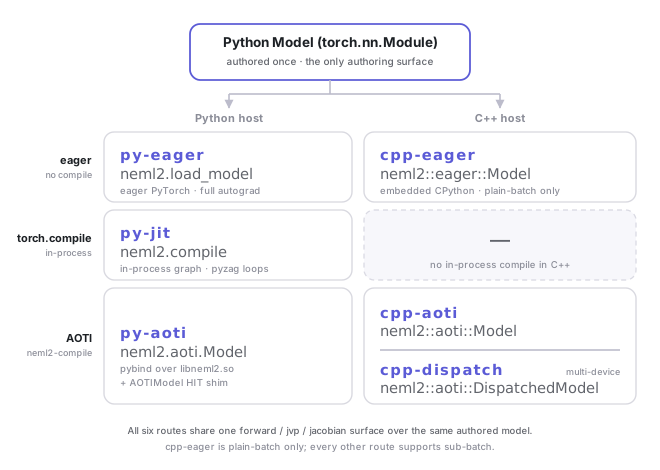
Fig. 1 The six routes by host (Python / C++) and mode (eager / torch.compile / AOTI).
A model is authored once in Python; the empty cell is real (there is no in-process
torch.compile route in C++).#
The four families differ in where the model runs and what it costs to start.
The AOTI family is one artifact (.pt2 package + metadata + HIT stub) consumed
by two different hosts — running a compiled model from C++ and from Python is the
same compile, not two.
At a glance#
Each runtime has a short codename of the form host-mode (py / cpp
crossed with eager / jit / aoti). Use it in bug reports and discussion
threads to say which path you’re on without a paragraph of description — “this
reproduces on cpp-aoti but not py-eager” is unambiguous.
Every runtime supports forward. They differ on sensitivities and on whether
they accept sub-batch models (e.g. crystal plasticity, which carries a per-slip
inner batch dimension — see Sub-batch axes for how the extent is
declared and which routes read it):
Codename |
Entry point |
Compile |
Host |
jvp / jacobian |
Sub-batch |
Primarily for |
|---|---|---|---|---|---|---|
|
|
none |
Python |
✓ |
✓ |
dev, testing, autograd training |
|
|
in-process JIT |
Python |
✓ (native) |
✓ |
pyzag training loops |
|
|
offline |
Python (pybind) |
✓ |
✓ |
compiled model from Python |
|
|
offline |
C++ |
✓ |
✓ |
production C++ deployment |
|
|
offline |
C++ |
✓ |
✓ |
multi-device throughput |
|
|
none |
C++ + embedded Python |
✓ |
✗ |
compile-free C++ tests |
Parameter derivatives. All six routes additionally expose the same
param_jacobian(inputs) -> (outputs, {out: {param: block}}) and
param_vjp(inputs, cotangents) -> {param: grad} surface for d(output)/d(parameter),
computed by reverse-mode autograd — a separate path from the forward-mode input
chain rule that backs jvp / jacobian. The eager routes (py-eager,
py-jit, cpp-eager) differentiate w.r.t. every parameter at call time
(params= selects a subset); the AOTI routes (py-aoti, cpp-aoti,
cpp-dispatch) return only the (output, parameter) pairs whose graphs were
compiled in — promote the parameter with -p NAME and request the pair with
-d OUT:NAME at neml2-compile time (see AOTI packages).
Parameter values at runtime. All six routes also share a parameter
read/write surface: named_parameters() returns the current values, and
set_parameter(name, value) updates one in place (a torch.no_grad copy on the
eager routes; a slot replacement on the AOTI routes, broadcast across devices for
cpp-dispatch). The new value is used on the next call.
Batched (per-batch-element) parameters. set_parameter also accepts a value
that carries a leading batch dimension — e.g. a Scalar parameter set to shape
(B,), a spatially varying material property and the common MOOSE
inverse-optimization case. The call batch is then
broadcast(input batches, parameter batches), and all of forward / jvp /
jacobian / param_jacobian / param_vjp return per-batch-element results on
every route (cpp-dispatch slices each batched parameter to each chunk’s rows).
Both parameter-derivative surfaces follow the parameter’s shape, matching the
eager semantics: param_jacobian returns a d(output)/d(parameter) block whose
trailing axes are (*param_base) (per batch element when the parameter is
batched), and param_vjp returns the adjoint dL/d(param) summed over the
batch for a global (unbatched) parameter but per-element (B, *param_base)
for a batched one — the latter being what reverse-mode autograd accumulates when
each batch element depends only on its own copy of the parameter. (cpp-dispatch
concatenates each batched parameter’s per-chunk adjoint and sums each global one.)
The routes#
Each route has its own reference page with the loading-and-calling API; the deployment guides cover the setup (install / build / artifacts) that comes first.
Python — set up with Python integration:
py-eager — eager Python — load and call the model directly; the default for development, interactive work, and autograd training.
py-jit — in-process torch.compile —
neml2.compileaccelerates the in-process graph, mainly for pyzag.py-aoti — compiled model from Python — load and run a compiled
.pt2package from Python.
C++ — set up with C++ integration:
cpp-aoti — compiled model from C++ — load a compiled
.pt2package vialibneml2.so.cpp-dispatch — dispatching across devices — the same artifact, chunked across CPU + GPU(s).
cpp-eager — eager evaluation from C++ — run a model from its
.iwith no compile (for C++ tests).
The three compiled routes (py-aoti, cpp-aoti, cpp-dispatch) share one
artifact — see AOTI packages for its format and
Compilation pipeline for how neml2-compile produces it. The command
line is a fourth way to drive a model with no code at all: CLI utilities.
Choosing a runtime#
Iterating, debugging, or training in Python →
py-eager. Reach forpy-jit(neml2.compile) only inside a pyzag loop where the residual is the hot path.Deploying into a C++ application →
cpp-aoti. Switch tocpp-dispatchwhen you need to saturate multiple GPUs (or CPU + GPU) with one batched call.Calling a compiled model from Python, or reproducing C++ numerics without a NEML2 source dependency →
py-aoti.C++ tests that can’t pay the compile cost →
cpp-eager.Sub-batch models (crystal plasticity and friends) run on every runtime except
cpp-eager. If you need a compiled sub-batch model in C++, usecpp-aoti.
Runtimes vs. consumers#
Several entry points are not runtimes themselves — they are consumers layered on one of the runtimes above:
neml2-run <input.i> <driver>and theDriverclasses (TransientDriver,ModelUnitTest,TransientRegression,Verification) step a model through a load history onpy-eager. If the input file names anAOTIModel, the same driver runs onpy-aotiinstead.The pyzag adapter (
NEML2PyzagModel) drives calibration onpy-eager, optionally accelerated topy-jitvianeml2.compile(model).neml2-inspect <input.i> <model>resolves and prints a model’s input/output graph but does not evaluate it.
The full tool reference is in CLI utilities.
See also#
Python integration / C++ integration / CLI utilities — set up neml2 in a Python app, a C++ build, or from the shell.
AOTI packages — the compiled-package format shared by the AOTI routes.
Compilation pipeline — what
neml2-compiledoes, stage by stage.Tutorials — end-to-end walkthroughs.
Migration guides — what changed across NEML2 versions.